

I wrote this blog for work back in July after attending Orangewood Foundation’s Sex Trafficking Forum. The contents of that education still haunt me and I don’t want its lesson to be lost over time. It’s not old news because we haven’t found the solution.
We live in an imperfect world and bad people will always find a way to inflict harm on their victims, but this doesn’t mean we throw in the towel. We fight.
Please take the time to read the forum recap below and listen to Oree’s story. She led the forum discussion that night and I couldn’t begin to describe the amount of strength this woman holds. Orangewood Foundation asks to please help spread awareness to help end the growing pandemic of sex slavery, we can all do our part.
Last night the Marconi Staff attended Orangewood Foundation’s Forum on sex trafficking in Orange County. The moving dialog from a survivor stirred up a fiery determination to do more in each staff member’s stomach.
The Marconi Foundation for Kids did recently donate $3,000 to the Orangewood Foundation, but it’s not nearly enough and there’s plenty of work to be done; we want to do more! The number one goal Orangewood has in regards to its sex trafficking program is to bring more awareness to this sensitive issue.
With the need for awareness on the brain, here is a recap of what was learned and spoken about on Monday night’s gathering.
Disclaimer: This post will use potentially alarming vocabulary to promote awareness about sex trafficking. Viewer discretion is advised.
Sex Trafficking Statistics:
- 100,000 – 300,000 American children are victims of sex trafficking per year.
- 1 out of every 3 runaway girls in the U.S. is approached by a pimp within 48 hours of running away.
- Almost 400 victims of sex trafficking in Orange County have been identified in the past 10 years and almost half of them were children.
- In the past two years 1,277 victims have been identified in California.
- 50-80% of sex trafficking victims in California are or once were in the foster care system.
- There were 145 victims in Orange County in 2014.
Q:What is sex trafficking?
A: The use of violence, threats, lies, debt bondage and other forms of coercion to compel adults and children to engage in commercial sex acts against their will. Also known as: sex slavery, human trafficking and Commercial Sexual Exploitation of Children (CSEC).
Terminology:
- “In the life”: involved in sex trafficking
- “John/Trick”: child molester; the buyer
- “Bottom bitch”: the pimp’s head girl
- “Wifey”: the girls who work with you and your pimp
Q: Who are these girls?
A: These girls are the regular “run-of-the-mill” children. It can happen to anyone.
Victims are predominately young females who are insecure, questioning their self-esteem or looking for a way out of an abusive family.
Listen to Sex Trafficking Advocate and Survivor, Oree Freeman, tell her story in the video below.
In addition to Oree telling the forum’s crowd her story, she shared numerous survivor stories, or in her terms, her “survivor sisters” stories.
“My survivor sister grew up in South County and like most young girls in Southern California, dreamed of becoming a model and walking the runways for the fashion world’s most elite. But, early on her dreams were crushed when she didn’t have the support from her parents. Determined to make it in the industry, she got in contact with a reputable agent who continually booked her in successful events that advanced her career.
Until one day, the gigs stopped and she had no money to support herself and didn’t want to ask her parents for help after they had previously voiced disapproval regarding her career choice. The agent became her pimp, even though he spent time furthering her career, turning her over was always his end goal.”
Kinds of pimps:
This kind of pimp (in above story) is considered a CEO Pimp; the character who has all the opportunity to give out and uses it to lure in victims.
A Romeo Pimp will wine and dine you for however long it takes until sold into the ring.
Women pimps are referred to as Madams and have usually been former workers “in the life.”
Recruiting Spots:
Any area where a large group of children frequent, i.e: bus stops, malls, skating rinks, group homes and the Internet.
Oree told the crowd she once walked into a skating rink during the afternoon and saw her ex-pimp and “bottom bitch” scouting out the mobs of kids, looking for the weakest link.
Girls’ Expectations:
One pimp’s formula his women must make:
- $600 to eat
- $800 to sleep
- Didn’t collect the money from the John, punishment was sleeping with the next man without a condom.
This math equates a need to make $208,000 a year and work 16 times a day for 5 days to achieve it. This means one woman experiences 4,160 rapes a year to be able to eat and sleep.
Other facts to keep in mind:
- Orange County is a number one destination location for sex trafficking because of its high prospect to make money.
- Sex trafficking is almost as lucrative as drug hustling because gangs are becoming more interested in selling kids than selling drugs, it’s “safer.”
- Recent reports have shown pimps come from violent upbringings and/or have experienced sexual assault while growing up.
- Sex trafficking victims often get mislabeled as prostitutes.
The Good News:
- The Orangewood Foundation has been working for nearly 35 years to care for abused and at-risk youth. The foundation has numerous programs to aid children in need.
- First responders are being taught how to recognize a sex trafficking victim and what questions to ask.
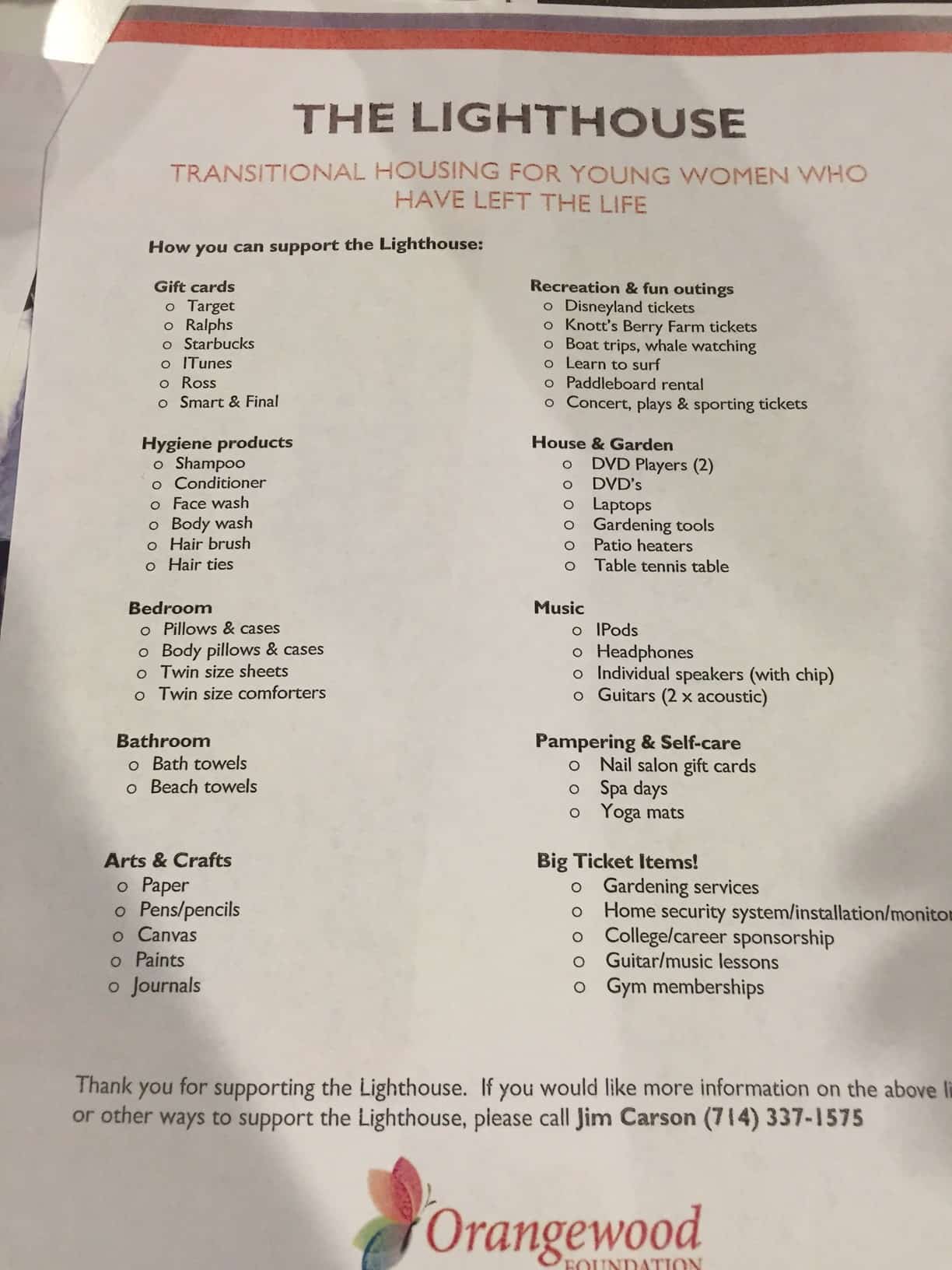
- The creation of a new program called The Lighthouse Program, by the Orangewood Foundation.
The Lighthouse Program is transitional housing for young women who have left “the life.” It’s a house with 24/7 care for women aged 18-21 (minors are generally placed in foster care) that will help a survivor recuperate and plan for their future, and stay as long as needed to become successful.
This program will work in tandem with other Orangewood programs which offer help with basic needs, independent living skills, employment and education.
As the first kind of home/program in the Orange County and L.A. area, the foundation needs our support. Below is a list detailing how YOU can support The Lighthouse.
If you are interested in attending a forum, the meetings happen every second Monday of every month from 6:30-8:00pm. Plan to be a part of the discussion on August 8th and September 12th at 1575 E. 17th St., Santa Ana.
Awareness is the first step in stopping the problem.

 RamblinRandol